Modern premium residences, especially minimalist interiors, demand extremely high precision. Many details in a space may look simple at first glance, but the simpler they appear, the more easily they reveal even the smallest inaccuracies.
In traditional styles, complex moldings, carvings, and decorative elements can distract the eye. But in modern minimalist spaces, cabinet doors, gaps, lighting, finishing edges, and material joints are all directly exposed to view. Even a 2–3 millimeter error can make a space feel less refined to the human eye.
So, the essence of “millimeter-level craftsmanship” is the ultimate control of spatial detail and precision. It is usually reflected in several key areas.

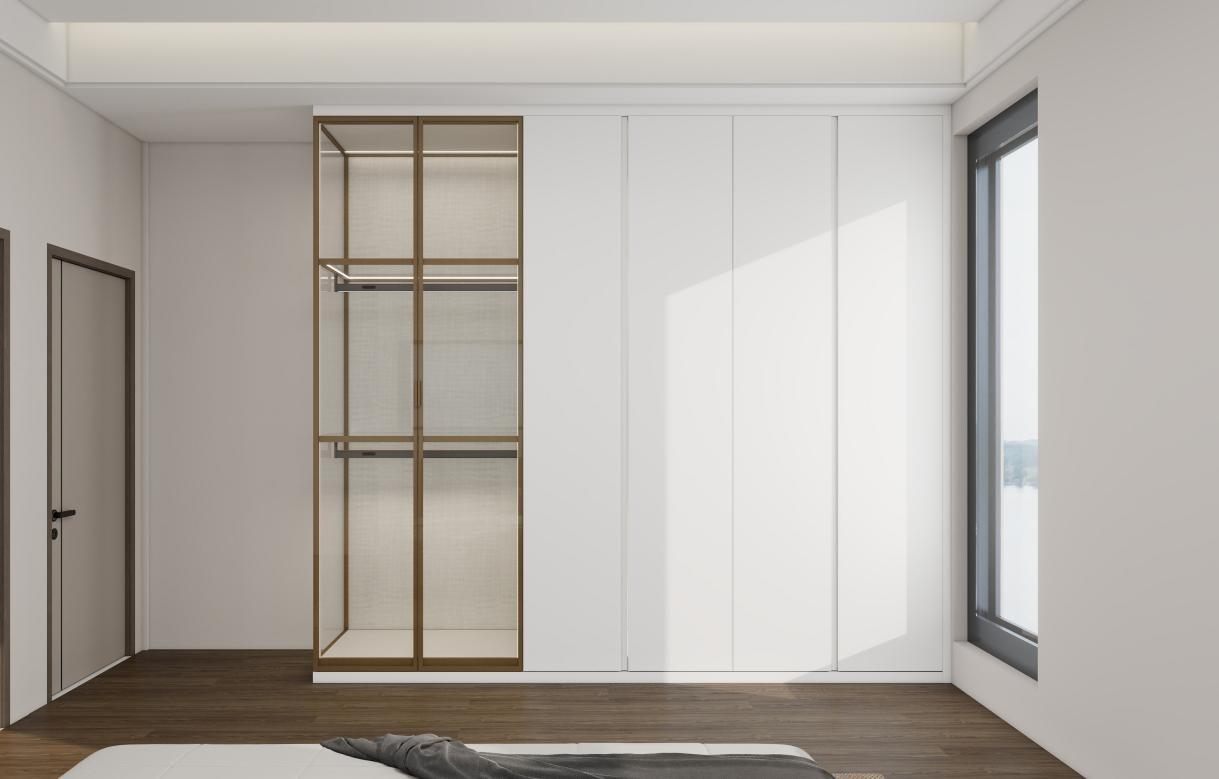
First is gap control between doors.
In high-end customization, the gaps between cabinet doors are never random. They are calculated and designed as part of the overall visual system. For example:
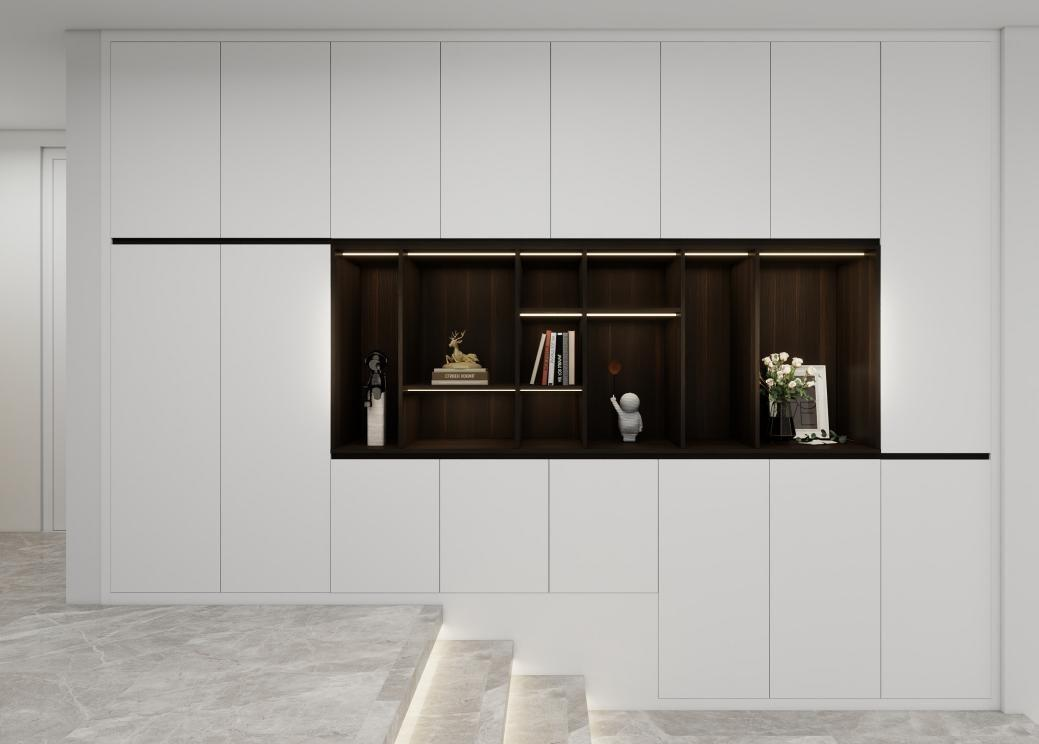
Whether the upper and lower gaps of cabinet doors are consistent;
whether the horizontal and vertical shadow lines are unified;
whether an entire row of cabinets maintains the same level line.
All of these directly affect the sense of order in a space. This is especially important now that many high-end residences use handleless systems, where visual attention becomes even more focused on the relationship between lines. If the door gaps are uneven or the cabinet doors are misaligned, the entire space will immediately appear rough.
In truly high-end projects, door gaps are often controlled within a very precise range and arranged according to unified proportions to create a more architectural sense of order.

The second area is edge finishing and transitions.
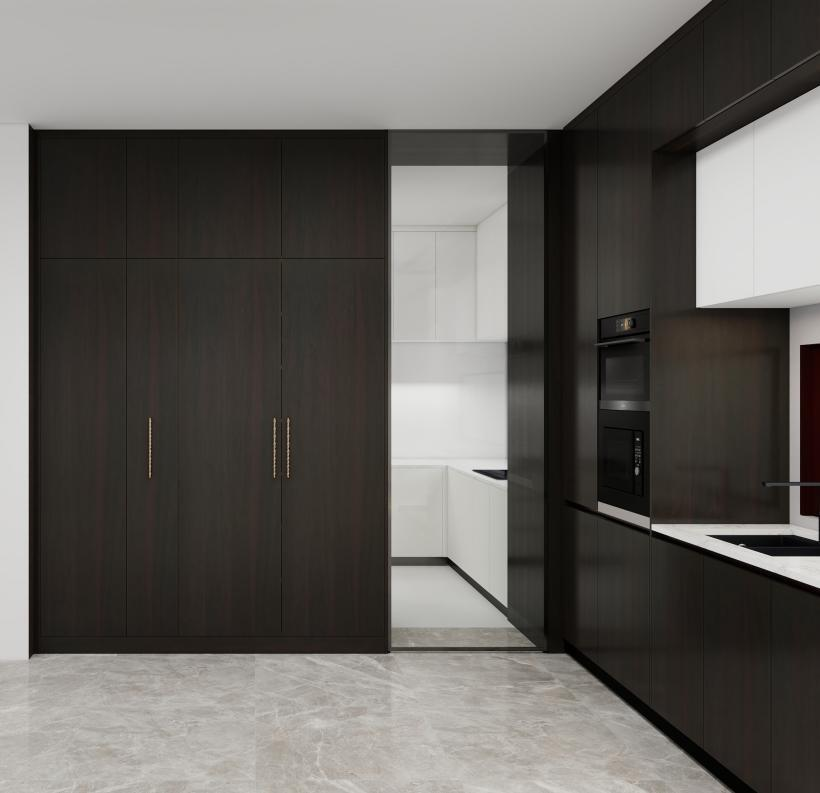
Finishing details are often where craftsmanship is most clearly revealed. Different materials inevitably meet within a space, such as:
Cabinetry and walls;
wood veneer and sintered stone;
cabinet doors and ceilings;
countertops and side panels.
If these junctions are not handled properly, problems may appear, such as uneven gaps, rough interfaces, or an obvious sense of material disconnection.
High-end projects typically use extremely narrow trims, seamless joints, shadow-gap detailing, and color-matched edge banding to create smoother and more natural transitions between different materials.
.jpg)
The third area is material matching and joining precision.
Modern high-end residences increasingly emphasize visual integrity, so many projects pay close attention to details such as:
Whether the wood grain is continuous;
whether the veining of sintered stone is aligned;
whether 45-degree mitered corners are clean;
whether glass and wood veneer surfaces are flush.
In wood veneer systems, grain matching is particularly demanding. In a truly refined space, the wood grain appears to flow continuously and naturally, rather than being pieced together in a chaotic way.

The fourth area is concealed lighting craftsmanship.
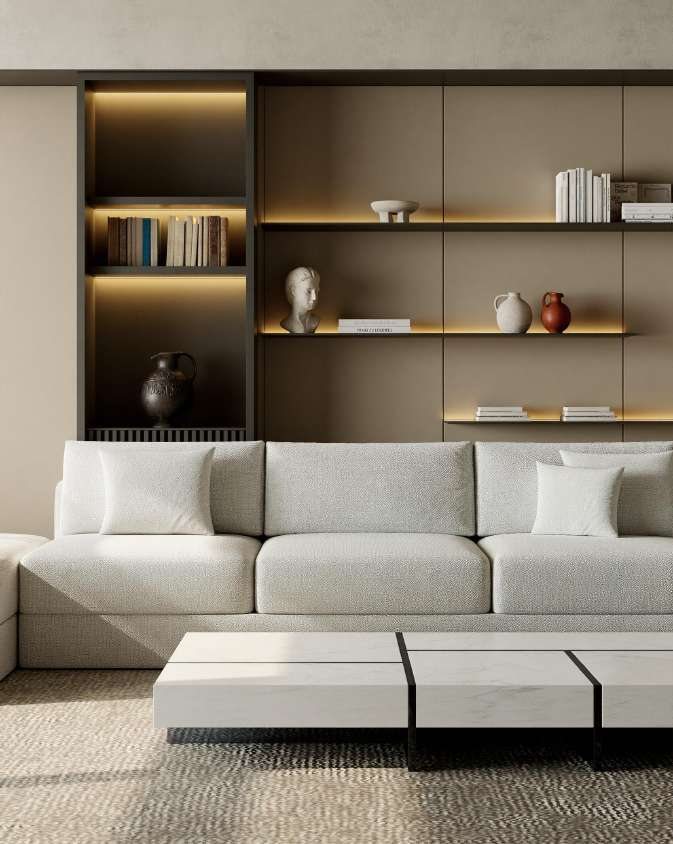
Many high-end residences today incorporate built-in cabinet lighting, floating light effects, indirect light grooves, and main-light-free lighting systems.
But premium lighting is not about having more lights. It is about “seeing the light, not the fixture.” This means the recessed depth, angle, and uniformity of light strips all require extremely precise structural control.
If the installation is inaccurate, issues such as broken light lines, exposed light strips, uneven brightness, and messy shadows may occur. These details can directly undermine the quality of the space.
In addition, floating structures are also an important expression of millimeter-level craftsmanship.
Many high-end residences now favor designs such as floating TV cabinets, floating bathroom cabinets, floating desks, and floating platforms, because floating design makes a space feel lighter and more refined.
The real challenge lies in making the structure look light while ensuring load-bearing capacity and stability. Behind this are often hidden steel reinforcements, concealed load-bearing structures, precise leveling, and integrated pre-installation of both lighting and structure.
Even a slight tilt or deformation can cause the entire minimalist space to lose its sense of balance.

Therefore, “millimeter-level craftsmanship” in high-end customization is not simply about making things look refined. It is about creating a highly unified spatial order.
A truly sophisticated space often does not feel complex at first glance. Instead, it feels comfortable, clean, and harmonious. That sense of luxury often comes from precision that may not be immediately noticed by the eye, but can be naturally felt by the body.
This is why the simpler a minimalist space appears, the more it relies on craftsmanship behind the scenes.